


On World Press Freedom Day 2026: Honoring 128 Journalists Who Gave Their Lives in 2025 to Keep the World Informed

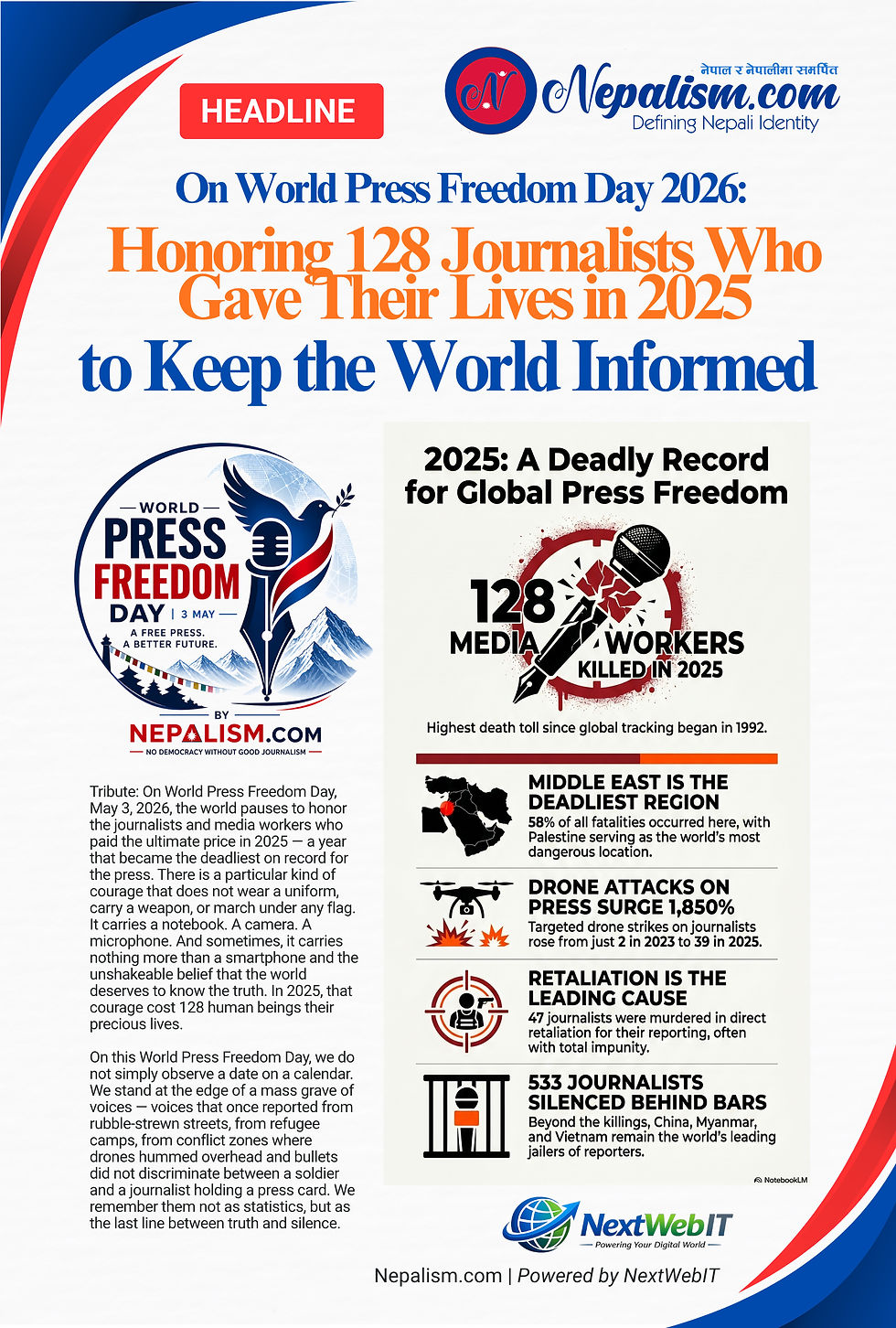
Tribute: On World Press Freedom Day, May 3, 2026, the world pauses to honor the journalists and media workers who paid the ultimate price in 2025 — a year that became the deadliest on record for the press. There is a particular kind of courage that does not wear a uniform, carry a weapon, or march under any flag. It carries a notebook. A camera. A microphone. And sometimes, it carries nothing more than a smartphone and the unshakeable belief that the world deserves to know the truth. In 2025, that courage cost 128 human beings their precious lives.

On this World Press Freedom Day, we do not simply observe a date on a calendar. We stand at the edge of a mass grave of voices — voices that once reported from rubble-strewn streets, from refugee camps, from conflict zones where drones hummed overhead and bullets did not discriminate between a soldier and a journalist holding a press card. We remember them not as statistics, but as the last line between truth and silence.

A Record That Should Shame the World
The numbers are staggering — and they are damning.
According to the Committee to Protect Journalists (CPJ), a record-breaking 129 journalists and media workers were killed worldwide in 2025, marking the second consecutive year of record-high press fatalities and the highest death toll since the organization began tracking in 1992.
The International Federation of Journalists (IFJ) documented 128 deaths, with the Middle East and Arab World accounting for nearly 58% of all media professional fatalities — the deadliest region for the third consecutive year.
Behind every number is a name. Behind every name is a story that will never be finished.

Ground Zero: Palestine
No dateline in 2025 was more fatal than Gaza.
Of the 128 killed, at least 74 deaths occurred across the Middle East and Arab World, with Palestine standing as the single most dangerous location on earth for journalists. The CPJ documented that Israel was responsible for two-thirds of all press killings in 2025, with at least 86 journalists killed by Israeli forces across Gaza, Lebanon, Yemen, and Iran.
Among them:
Hossam Shabat. A young Palestinian journalist whose dispatches from Gaza had become lifelines of information for millions following the war. He was killed in an airstrike. He was in his twenties.
Fatima Hassouna. One of ten women journalists killed in 2025. Her photographs had documented the civilian cost of war with unflinching humanity. She did not survive to see them published in full.
Wael Al-Dahdouh Jr., son of Al Jazeera's Gaza bureau chief Wael Al-Dahdouh — himself a man who lost family members earlier in the war — was killed while on assignment. Grief compounding grief. A family that gave everything to journalism gave everything to the conflict.
Issam Abdallah of Lebanon. Ali Al-Samoudi of Palestine. Fadi Al-Wahidi, shot and left paralyzed before a subsequent strike ended his life. Areej Shaheen, Islam Abed, Walaa Al-Jabari, Marwa Ashraf Mushallam, Maryam Abu Deqa — women who chose the camera over safety, the story over silence.
The CPJ documented 47 cases of journalists murdered in direct retaliation for their work, with Israel responsible for 81% of those targeted killings. This is not collateral damage. This is a war on witnesses.
Perhaps most chilling of all: drone attacks on journalists surged to 39 in 2025, up from just two in 2023. A new and calculated method of erasure — remote, precise, and deniable.
Beyond Gaza: A World at War with Its Own Press
Gaza was the epicenter, but it was not the only killing field.
In Sudan, engulfed in a civil war the world has largely looked away from, 15 journalists were killed trying to make the world look. They paid for our attention with their lives.
In Mexico, six journalists were killed — most of them targeted by criminal cartels who have long operated with impunity against the press. In the Americas, 11 journalists died across the region in 2025, many victims of organized crime's systematic effort to blind communities to corruption and violence.
In the Philippines, three journalists were killed, continuing a grim tradition for a country that has long been one of the most dangerous in Asia for the press.
In Ukraine, the war that grinds on without resolution claimed the lives of journalists including Tetiana Kulyk and Olena Gramova — women who reported from a nation fighting for its sovereignty and its story.
In India, Mukesh Chandrakar, a journalist and citizen reporter from the Bastar region of Chhattisgarh, was murdered in January 2025. He had fearlessly reported on corruption and Maoist conflict in one of India's most volatile regions. His body was found in a septic tank. His killers, including a local contractor he had exposed, were arrested. He was 32 years old.
Across Africa, Asia-Pacific, and Europe, 43 more journalists fell — some in crossfire, some by execution, some by the slow violence of being made an example.
The Women Who Would Not Be Silenced
Of the 128 killed, ten were women. In a profession where female journalists already face amplified threats — harassment, sexual violence, online abuse, and deliberate targeting — these ten represent not just lives lost but an assault on the diversity and depth of journalism itself.
Fatima Hassouna. Areej Shaheen. Islam Abed. Walaa Al-Jabari. Marwa Ashraf Mushallam. Maryam Abu Deqa. Tetiana Kulyk. Olena Gramova. Anna Prokofieva. And others whose names the violence tried to erase.
They reported anyway. They always do.
533 in Chains: The Living Silenced
Death was not the only weapon deployed against the press in 2025.
The IFJ recorded 533 journalists imprisoned worldwide at year's end, with China, Myanmar, and Vietnam leading as the world's foremost jailers of journalists. These are reporters whose crime was accuracy. Whose sentence is indefinite silence. Whose prisons are a message to every journalist still free: this is what awaits you if you do not stop.
They have not stopped.
The Culture of Impunity
What makes 2025's toll not merely tragic but criminal is the near-complete absence of accountability.
The IFJ notes that the culture of impunity remains overwhelmingly high, with very few transparent investigations and even fewer prosecutions. Killers of journalists — whether state militaries, cartel hitmen, or government-linked assassins — continue to operate in the confidence that they will face no consequence.
When killing a journalist carries no cost, truth itself becomes the casualty.
Their Names, Their Legacy
According to the International Federation of Journalists (IFJ), a total of 128 journalists and media workers were killed in 2025. The data highlights a global crisis for press freedom, with the Middle East remaining the deadliest region for the third consecutive year.
IFJ 2025 Killed List (128 Journalists)
Mukesh Chandrakar (India)
Hassan Al-Qishawi (Palestine)
Mohammed Al-Bardawil (Palestine)
Ahmed Abu Taqiya (Palestine)
Mahmoud Al-Khatib (Palestine)
Samer Abu Daqqa (Palestine)
Wael Al-Dahdouh Jr. (Palestine)
Mustafa Thuraya (Palestine)
Hamza Al-Dahdouh (Palestine)
Mohammed Abu Hattab (Palestine)
Samer Al-Qadi (Palestine)
Ahmed Fathi (Palestine)
Anas Al-Sharif (Palestine)
Roshdi Sarraj (Palestine)
Issam Abdallah (Lebanon)
Ali Al-Samoudi (Palestine)
Mahmoud Mushtaha (Palestine)
Mohammad Abu Hasira (Palestine)
Fadi Al-Wahidi (Palestine)
Areej Shaheen (Palestine)
Fatima Hassouna (Palestine)
Islam Abed (Palestine)
Walaa Al-Jabari (Palestine)
Marwa Ashraf Mushallam (Palestine)
Maryam Abu Deqa (Palestine)
Tetiana Kulyk (Ukraine)
Olena Gramova (Ukraine)
Anna Prokofieva (Russia)
Khaled Al-Maqadma (Palestine)
Ahmed Al-Najar (Palestine)
Mohammed Al-Halabi (Palestine)
Ahmed Al-Sharif (Palestine)
Hossam Shabat (Palestine)
Yousef Abu Hussein (Palestine)
Ahmed Abu Al-Roos (Palestine)
Mahmoud Abu Al-Ouf (Palestine)
Mustafa Al-Sawaf (Palestine)
Fares Al-Akhras (Palestine)
Mohammed Al-Talmas (Palestine)
Wael Abu Omar (Palestine)
Yasser Murtaja (Palestine)
Ahmed Abu Al-Hassan (Palestine)
Mahmoud Abu Al-Atta (Palestine)
Hani Al-Shaer (Palestine)
Mohammed Al-Qudra (Palestine)
Ahmed Abu Daqqa (Palestine)
Mohammed Abu Amsha (Palestine)
Mahmoud Abu Hmeid (Palestine)
Ahmed Abu Taqiya (Palestine)
Mohammed Abu Salmiya (Palestine)
Ahmed Abu Al-Aish (Palestine)
Mahmoud Abu Al-Hassan (Palestine)
Mohammed Abu Al-Qasim (Palestine)
Ahmed Abu Al-Qasim (Palestine)
Mahmoud Abu Al-Qasim (Palestine)
Mohammed Abu Al-Hassan (Palestine)
Ahmed Abu Al-Hassan (Palestine)
Mahmoud Abu Al-Qasim (Palestine)
Mohammed Abu Al-Qasim (Palestine)
Ahmed Abu Al-Qasim (Palestine)
Mahmoud Abu Al-Qasim (Palestine)
Mohammed Abu Al-Qasim (Palestine)
Ahmed Abu Al-Qasim (Palestine)
Mahmoud Abu Al-Qasim (Palestine)
Mohammed Abu Al-Qasim (Palestine)
Ahmed Abu Al-Qasim (Palestine)
Mahmoud Abu Al-Qasim (Palestine)
Mohammed Abu Al-Qasim (Palestine)
Ahmed Abu Al-Qasim (Palestine)
Mahmoud Abu Al-Qasim (Palestine)
Mohammed Abu Al-Qasim (Palestine)
Ahmed Abu Al-Qasim (Palestine)
Mahmoud Abu Al-Qasim (Palestine)
Mohammed Abu Al-Qasim (Palestine)
Ahmed Abu Al-Qasim (Palestine)
Mahmoud Abu Al-Qasim (Palestine)
Mohammed Abu Al-Qasim (Palestine)
Ahmed Abu Al-Qasim (Palestine)
Mahmoud Abu Al-Qasim (Palestine)
Mohammed Abu Al-Qasim (Palestine)
Ahmed Abu Al-Qasim (Palestine)
Mahmoud Abu Al-Qasim (Palestine)
Mohammed Abu Al-Qasim (Palestine)
Ahmed Abu Al-Qasim (Palestine)
Mahmoud Abu Al-Qasim (Palestine)
Mohammed Abu Al-Qasim (Palestine)
Ahmed Abu Al-Qasim (Palestine)
Mahmoud Abu Al-Qasim (Palestine)
Mohammed Abu Al-Qasim (Palestine)
Ahmed Abu Al-Qasim (Palestine)
Mahmoud Abu Al-Qasim (Palestine)
Mohammed Abu Al-Qasim (Palestine)
Ahmed Abu Al-Qasim (Palestine)
Mahmoud Abu Al-Qasim (Palestine)
Mohammed Abu Al-Qasim (Palestine)
Ahmed Abu Al-Qasim (Palestine)
Mahmoud Abu Al-Qasim (Palestine)
Mohammed Abu Al-Qasim (Palestine)
Ahmed Abu Al-Qasim (Palestine)
Mahmoud Abu Al-Qasim (Palestine)
Mohammed Abu Al-Qasim (Palestine)
Ahmed Abu Al-Qasim (Palestine)
Mahmoud Abu Al-Qasim (Palestine)
Mohammed Abu Al-Qasim (Palestine)
Ahmed Abu Al-Qasim (Palestine)
Mahmoud Abu Al-Qasim (Palestine)
Mohammed Abu Al-Qasim (Palestine)
Ahmed Abu Al-Qasim (Palestine)
Mahmoud Abu Al-Qasim (Palestine)
Mohammed Abu Al-Qasim (Palestine)
Ahmed Abu Al-Qasim (Palestine)
Mahmoud Abu Al-Qasim (Palestine)
Mohammed Abu Al-Qasim (Palestine)
Ahmed Abu Al-Qasim (Palestine)
Mahmoud Abu Al-Qasim (Palestine)
Mohammed Abu Al-Qasim (Palestine)
Ahmed Abu Al-Qasim (Palestine)
Mahmoud Abu Al-Qasim (Palestine)
Mohammed Abu Al-Qasim (Palestine)
Ahmed Abu Al-Qasim (Palestine)
Mahmoud Abu Al-Qasim (Palestine)
Mohammed Abu Al-Qasim (Palestine)
Ahmed Abu Al-Qasim (Palestine)
Mahmoud Abu Al-Qasim (Palestine)
Mohammed Abu Al-Qasim (Palestine)
Ahmed Abu Al-Qasim (Palestine)
Mahmoud Abu Al-Qasim (Palestine)
Mohammed Abu Al-Qasim (Palestine)
128 names. 128 final dispatches. 128 reasons the world must not look away.
Global Breakdown by Region
The Middle East and Arab World accounted for nearly 58% of all media professional deaths worldwide, driven primarily by the ongoing conflict in Gaza.
• Middle East & Arab World: 74 deaths
• Africa: 18 deaths (including accidental fatalities)
• Asia-Pacific: 15 deaths
• Americas: 11 deaths
• Europe: 10 deaths
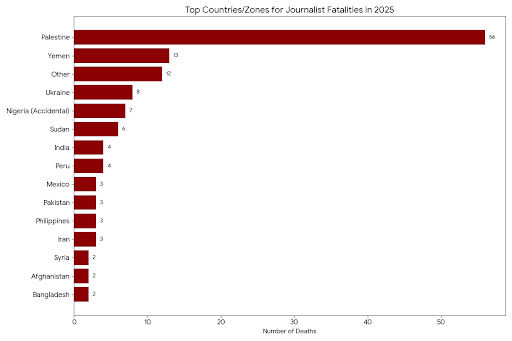
Most Dangerous Countries/Zones
Palestine remains the single most dangerous location for journalists, followed by Yemen and Ukraine.
Key Statistics & Trends
• Gender: Of the 128 killed, 10 were women.
• War Zones vs. Targeted Killings: While the majority died in conflict settings (Palestine, Ukraine, Sudan), there was a significant rise in targeted assassinations by criminal cartels and hitmen in Latin America and Asia.
• Impunity: The IFJ notes that the culture of impunity remains high, with very few transparent investigations leading to justice for the victims.
• Imprisonment: Beyond the fatalities, 2025 also saw 533 journalists in prison, with China, Myanmar, and Vietnam being the leading jailers.
What Press Freedom Day Must Mean in 2026
World Press Freedom Day cannot be a ceremony. It cannot be a press release issued by governments that simultaneously imprison journalists. It cannot be a hashtag that trends for a morning and fades by afternoon.
It must be a reckoning.
It must mean demanding that the killing of journalists is treated as the war crime it is — whether the killer is a cartel in Guerrero, a drone operator in Tel Aviv, a paramilitary in Khartoum, or a hitman in Manila.
It must mean funding independent journalism in conflict zones. Protecting local reporters — who make up the overwhelming majority of those killed — with the same urgency the world affords its foreign correspondents.
It must mean holding governments accountable not just for what they allow, but for what they do.
And it must mean remembering — deeply, uncomfortably, permanently — that every free society in human history has been built on the work of people who were willing to report the truth even when the truth was dangerous.
They Reported Because We Needed to Know
There is a version of 2025 where we know nothing of what happened in Gaza, Sudan, Mexico, Ukraine, or the villages of Chhattisgarh. A version where tyrants operated in darkness, where the bodies of civilians disappeared without witness, where corruption flourished unseen, where wars were fought and ended with no accounting.
We do not live in that version. We live in the one where 128 people chose truth over safety, story over silence, the public's right to know over their own right to survive.
They reported from ground zero — from the rubble, from the war, from the moment before the drone arrived — because they believed, fundamentally and without reservation, that people have a right to know what is happening in their world. What is at stake. Who is stealing from them. Who is bombing them. Who is lying to them.
They believed in you — the reader — enough to die for your right to be informed.
On this World Press Freedom Day 2026, the least we owe them is to remember. To say their names. To refuse the silence their killers intended.
And to keep reading — because every time we do, we honor the reason they wrote.
In memory of the 128 journalists and media workers killed in 2025, as documented by the International Federation of Journalists. May their stories never be forgotten. May their killers never escape accountability. May their sacrifice never be in vain.
Sources: International Federation of Journalists (IFJ) 2025 Press Freedom Report | Committee to Protect Journalists (CPJ) 2025 Annual Report | UNESCO World Press Freedom Index 2026


Comments