


Rabi’s Roar: “Once They Are Brought Down to Zero, Nepal Becomes a Hero”

Updated: Dec 20, 2025
Lamichhane Calls for Public Mandate to Defeat Corruption
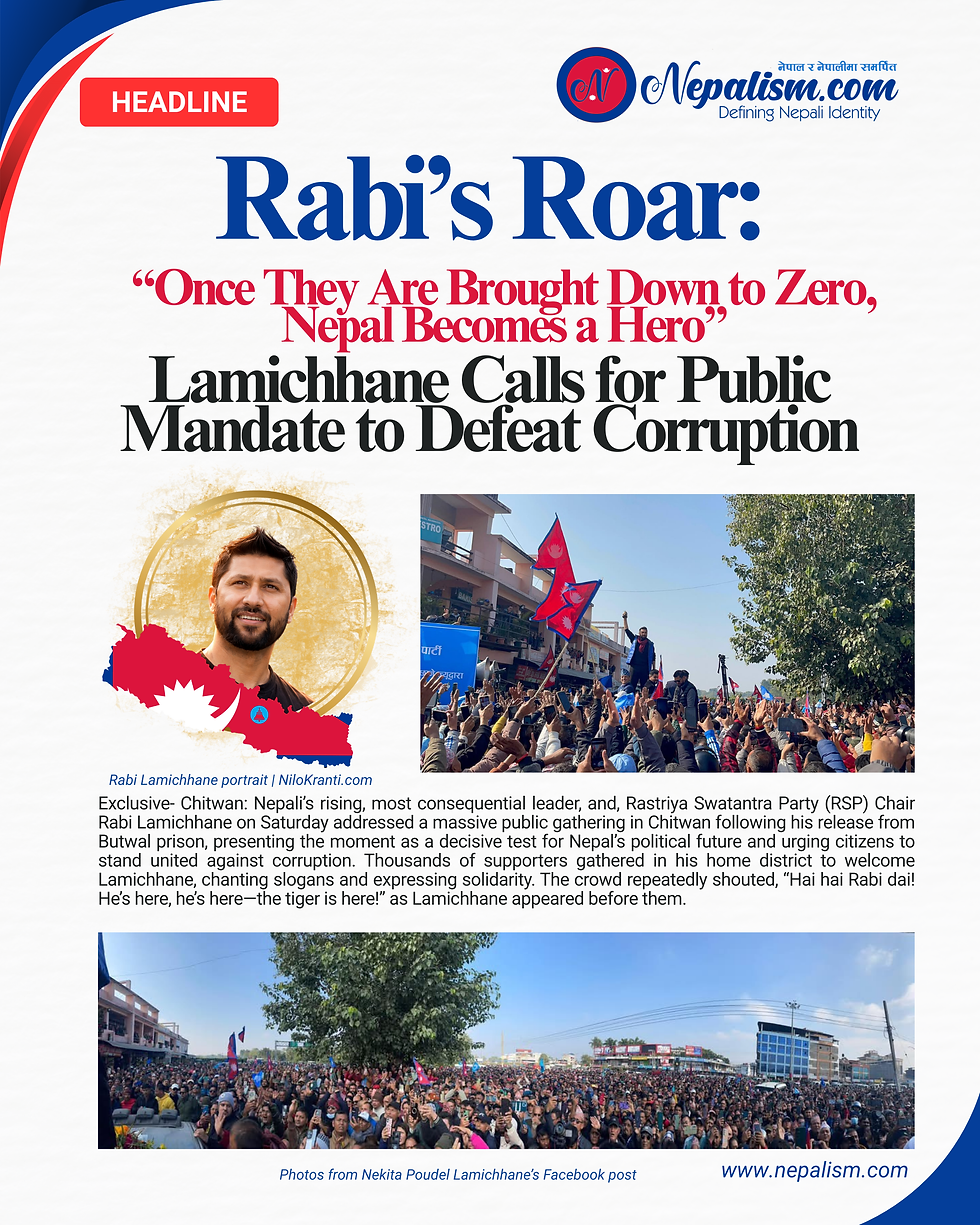
Updated: Exclusive- Chitwan: Nepali’s rising, most consequential leader, and, Rastriya Swatantra Party (RSP) Chair Rabi Lamichhane on Saturday addressed a massive public gathering in Chitwan following his release from Butwal prison, presenting the moment as a decisive test for Nepal’s political future and urging citizens to stand united against corruption.
Thousands of supporters gathered in his home district to welcome Lamichhane, chanting slogans and expressing solidarity. The crowd repeatedly shouted, “Hai hai Rabi dai! He’s here, he’s here—the tiger is here!” as Lamichhane appeared before them.
In his address, Lamichhane called for restraint amid heightened political tensions, while asserting that the country was on the brink of a new political direction shaped by the will of the people.
Referring to the violence and state repression of Bhadra 23 (September 8) and the events that followed on the 24th, Lamichhane described the youth-led Gen-Z movement as a genuine Jana Andolan (people’s movement). He vowed that the bloodshed during the protests would not be in vain and characterized the uprising as a peaceful revolt ignored by those in power.
“I will not let even a single drop of the blood of Gen-Z brothers and sisters go to waste,” Lamichhane said. “The peaceful rebellion we began—the Blue Revolution—was ignored. These are people who understand kicks, not words.”
He explicitly endorsed the protests, stating that “the 24th was a people’s movement,” framing the Gen-Z uprising as reflective of public aspirations and popular sentiment.
Rabi reassured the Gen Z brothers and sisters, speaking to them like a guardian, and said:
“We will build Singha Durbar. We will build the Parliament building, and we will build the judiciary as well. But who will build our dreams that have been reduced to ashes for years? We will. We will build them carrying the support of Gen Z. Gen Z brothers and sisters, Rabi dai is with you—so why worry?”
Lamichhane emphasized that the struggle for change was collective rather than personal, saying it was backed by citizens across Nepal and by Nepalis living abroad. He added that the movement would continue until it reached a definitive conclusion.
Responding to questions about his political future, Lamichhane alleged that repeated legal cases and institutional actions were aimed at sidelining him from public life. While acknowledging his removal from Parliament and the multiple cases filed against him, he maintained that such actions could not erase public support.
“Attempts may be made to reduce me to zero,” he said, “but the real question is whether corruption will be reduced to zero.”
“If You Can, Remove Me From the People’s Hearts”
Addressing concerns about whether he would be allowed to contest elections but prevented from holding office, Lamichhane said the measures taken against him amounted to political persecution.
“Will you at least allow me to be human?” he asked. “Even if I am only a human being, Ravi Lamichhane is enough to turn the palaces of the corrupt to ashes. You made me stateless. You pushed me out of Parliament with false cases. But can you remove me from the people’s hearts?”
Lamichhane said he was prepared to face further legal challenges and rejected claims that he would retreat from confrontation. He argued that political accountability required courage and direct engagement.
“I am no longer the Rabi Lamichhane of yesterday,” he said. “They did not let me remain that way. Even standing on a pile of false cases, even as an individual, I will bring down the palaces of the corrupt.”
He further declared:
“Does Lamichhane run away like those who flee in helicopters? He confronts them. File more cases—I have nothing to say.”
“Once They Are Brought Down to Zero, Nepal Becomes a Hero”
Calling on voters not to divide their support, Lamichhane framed the upcoming political choice as a direct referendum on corruption.
“Either reduce me to zero or reduce them to zero,” he said. “Don’t split your vote. Once they are brought down to zero, Nepal becomes a hero.”
Addressing Nepalis both at home and abroad, Lamichhane said carrying the people’s mandate could lead either to the seat of power at Singha Durbar or to imprisonment at Nakkhu Jail, but insisted that abandoning public trust was not an option.
“Why should I be afraid?” he said. “When you carry the people’s mandate, you either reach Singha Durbar or end up in Nakkhu. But I will never abandon the people’s mandate.”
Lamichhane concluded by stating that the movement was not about personal victory but about ensuring a better future for present and future generations. He said meaningful political change would create conditions for Nepalis working abroad to return home and build their future in Nepal.
“The Nepali people must win,” he said. “Not just today’s generation, but those yet to be born. We will seek our future in this country. We will fight—again and again—until that future is secured.”


Comments