


Historic State Apology to the Dalit Community by RSP Chair Ravi Lamichhane Speaks from Sovereign Nepali Parliament


EXCLUSIVE: Ravi Lamichhane — Chairman of the Rastriya Swatantra Party (RSP), former Deputy Prime Minister, and Member of Parliament — has issued a historic public and collective apology from the floor of Nepal's sovereign Parliament, acknowledging centuries of institutionalized state discrimination against the Dalit community. The RSP secured the new government with a near two-thirds majority. Speaking in the newly elected House of Representatives on Thursday, April 2, 2026, Chairman Lamichhane characterized the discrimination long suffered by Dalits not merely as a social failing, but as "organized crime"perpetrated by the state itself. He declared that "no Nepali should ever again have to bow before caste," and pledged that "justice will now give meaning to this apology" — committing the government to ensuring that such discrimination is permanently eradicated through the rule of law.
Tragically, however, this landmark declaration — a call to uproot the caste-based untouchability system that has long stood as a stain on Nepali society — received scant attention from most media outlets. Even more disheartening, certain self-styled Dalit activists, driven by personal animosity toward Lamichhane and the RSP, withheld any recognition or praise. Those so-called champions of Dalit rights who have used the Dalit cause merely to line their own pockets will never be forgiven — neither by the nation nor by the true Dalit community.
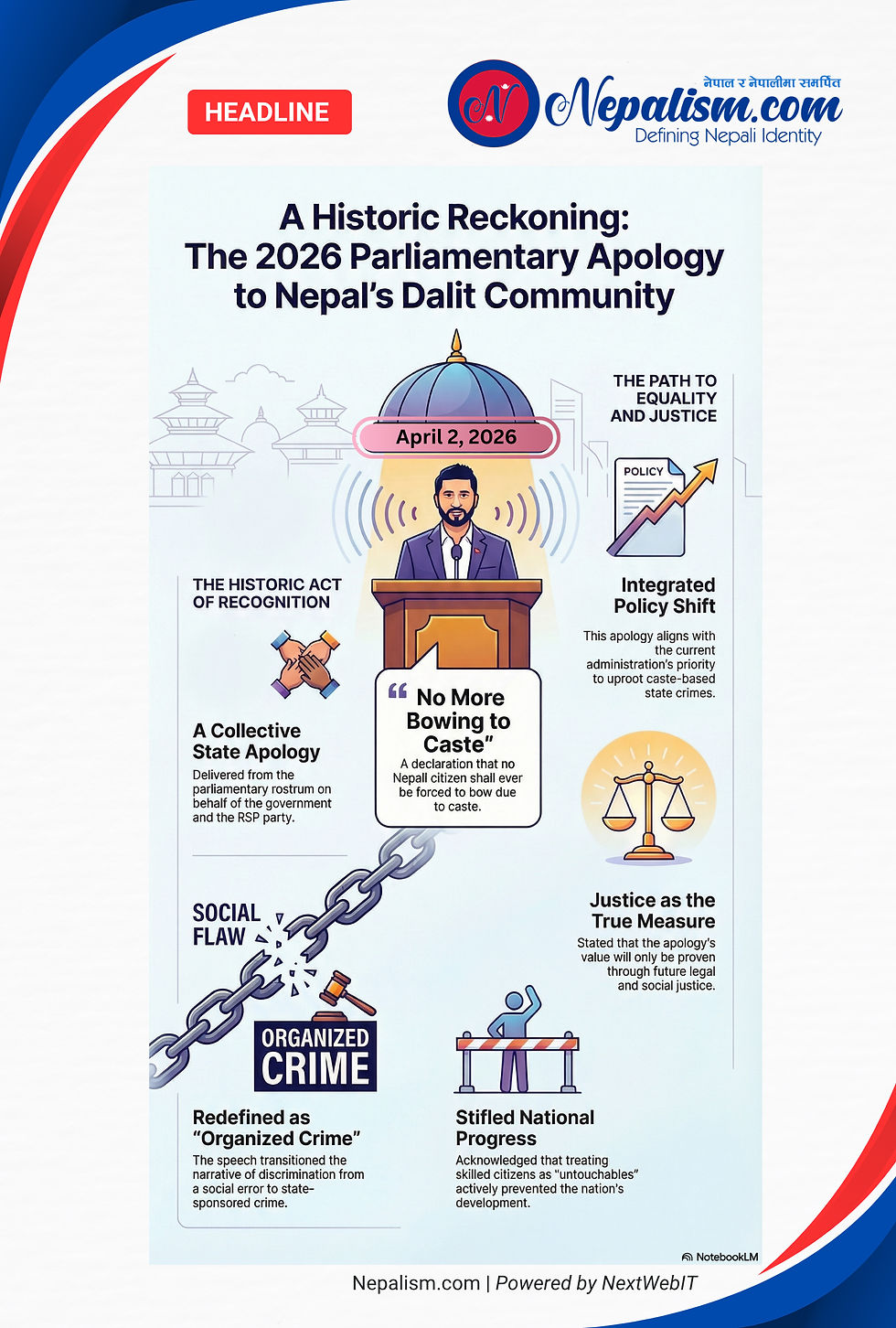
Lamichhane's Address — In His Own Words:
"I wish to speak today to the Dalit community of this nation, with a public apology. For the first time, this government is offering a collective and public acknowledgment — from this very chamber — for centuries of discrimination, injustice, and oppression."

Having delivered these words from the rostrum, Lamichhane bowed his head in a gesture of humble respect. The majority of lawmakers present responded with thunderous applause, recognizing the profound and historic nature of his address.

This was no casual remark made by a well-meaning member of a so-called upper caste in some public debate — no hollow declaration of "I've eaten at a Dalit home" or "Dalits are my friends."
Nor was it the kind of silence long maintained by self-proclaimed Dalit leaders who have spent thirty-five years cultivating power and privilege in the name of Dalit rights, while the community's suffering remained unchanged — never uttering a word against it out of partisan self-interest.

Yes, Ravi Lamichhane is a Brahmin — categorized within Nepal's so-called upper-caste hierarchy. But he is also the foremost political leader of present-day Nepal: the Chairman of the RSP, the party that leads the current Balen-RSP government with a near two-thirds majority. To downplay or ignore the far-reaching historical significance of his address to Parliament would itself be a grave mistake — one that history would judge harshly.
Remarkably, some self-styled Dalit activists have already begun voicing opposition on social media, arguing that Lamichhane's apology is insufficient and that Prime Minister Balendra Shah must also personally apologize. This response speaks to a troubling tendency in our society: offer a finger, and some will demand the whole hand.
It should be noted that among the 100 decisions made by the Balen government in its very first Cabinet meeting, one was a formal apology to the Dalit community for past discrimination. Prime Minister Balendra Shah, as the chief executive of the nation, will address the country when presenting the government's policies and programmes in the near future. Yet even now — when Lamichhane has stepped forward to apologize on behalf of not only the government but his own party as well — many among us cannot find the grace to express appreciation, support, or gratitude. What does that say about our collective conscience?
From the Rostrum — His Full Statement
"The discrimination that has persisted until today was not a social mistake — it was organized crime. We know why this country failed to reach its potential: because those with the greatest skill were branded as untouchables. No Nepali should ever again be made to bow before caste. I offer this apology on behalf of my entire party, on behalf of the Honorable Prime Minister, and on behalf of the government. And I wish to make one thing clear: justice will now determine the true value of this apology."
Before delivering this historic address, Lamichhane referenced an incident involving Khagendra Sunar — a fellow RSP member elected to Parliament — who had publicly apologized amid rumors of wrongdoing during the election campaign, despite being uncertain of any actual fault. Lamichhane said:
"My colleague, the Honorable Khagendra Sunar, has been elected and now sits in this chamber. When controversy arose around him during the campaign, he apologized — swiftly and without hesitation. He said, 'I don't believe I made that mistake, but if I did, I am sorry.' Today, from this entire House, I wish to ask this nation: Khagendra Sunar apologized when he was uncertain whether he had even done anything wrong. Have we ever apologized to people like Khagendra Sunar — for centuries of injustice inflicted upon them?"
Ravi Lamichhane — the architect of Nepal's "Blue Revolution," a vision of good governance and development achieved without shedding a single drop of Nepali blood — has, by sounding the trumpet of equality from Nepal's sovereign Parliament, positioned himself firmly at the forefront of the struggle to end all forms of discrimination. As the leader of the nation's largest party, born into privilege, he chose to speak as a true human being.
This generation will remember him — and so will generations yet to come. Nepalism salutes this historic act and honors the man behind it.


Comments