


Nepali Diaspora: We Are the 20 Percent-Voices and Aspirations

Updated: May 14

by Pradeep Pariyar Thapa
Updated: Exclusive: Opinion- Once a Nepali, Always a Nepali. This motto resonates in every corner of the world where Nepalis live, struggle, work, and thrive. The Nepali diaspora — numbering between six and eight million — represents approximately 20 percent of Nepal's total population of 29 million. History is unambiguous: no nation achieves prosperity without the active participation of its citizens in rebuilding it. We, the diaspora Nepalis living abroad, send home remittances that account for a staggering 28 percent of the nation's GDP. We are the backbone of Nepal's liquid economy — yet we remain without a voice at the table in Nepal's political discourse. That must change, and it must change now. Nepal cannot prosper without attracting its diaspora citizens back into the fold, and welcoming them with open arms is the only path forward.
The Exodus — And Why It Happens
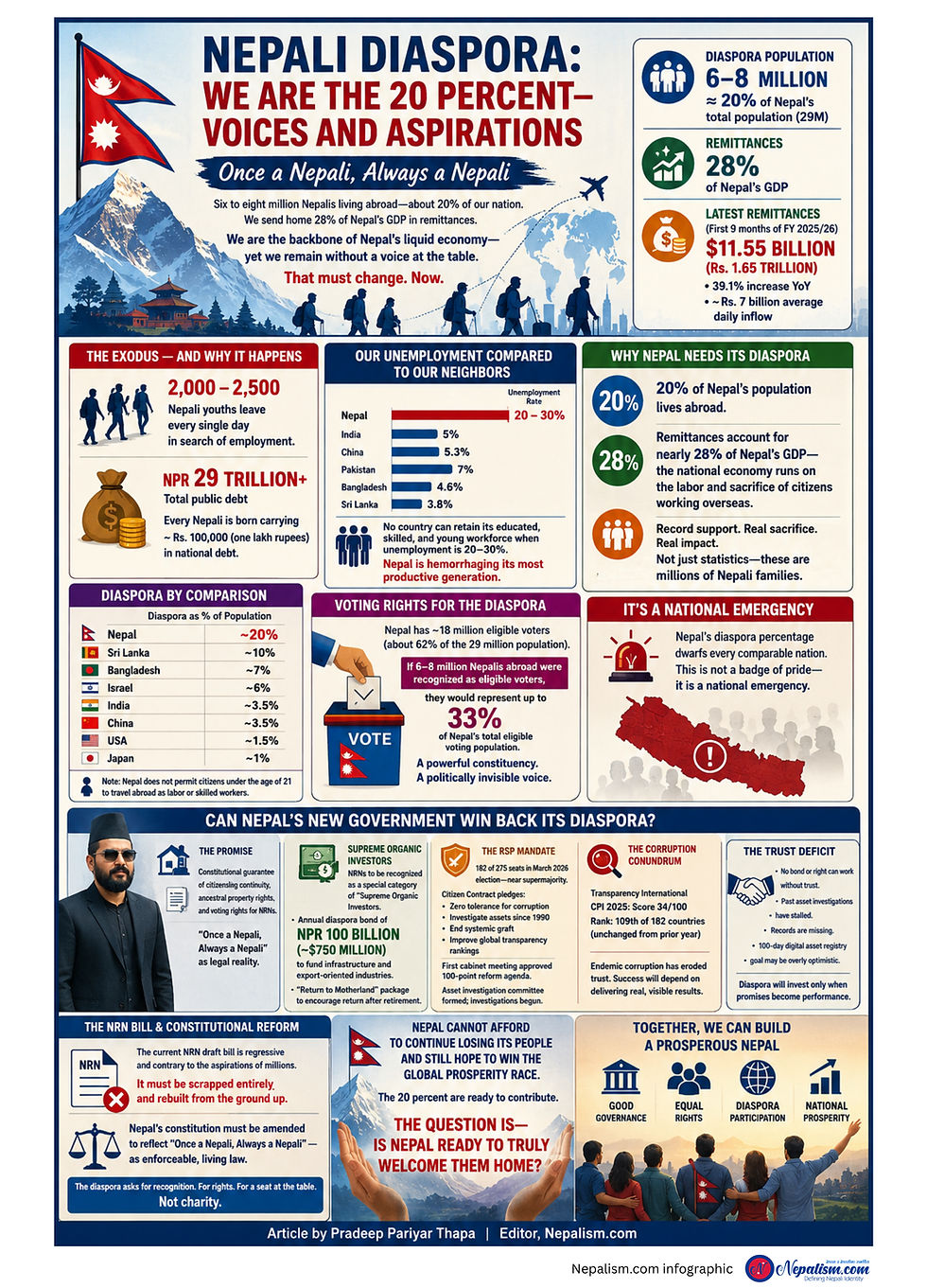
Between 2,000 and 2,500 Nepali youths leave the country every single day in search of employment, driven out by an unemployment rate that hovers between 20 and 30 percent. The country's total public debt has surpassed NPR 29 trillion, placing a crushing burden on public finances — meaning every Nepali citizen is born carrying a personal share of roughly Rs. 100,000 (one lakh rupees) in national debt.
Our Unemployment Compared to Our Neighbors
The contrast is stark. India's unemployment rate stands at just 5 percent; China's at 5.3 percent. Pakistan's sits at 7 percent, Bangladesh's at 4.6 percent, and Sri Lanka's at a mere 3.8 percent. No country can retain its educated, skilled, and young workforce when unemployment reaches 20 to 30 percent. Nepal is hemorrhaging its most productive generation — and the numbers prove it.

Why Nepal Needs Its Diaspora
Here is the defining figure: 20 percent. That is the share of Nepal's population living abroad. The remittances they send home account for nearly 30 percent of Nepal's GDP — a sobering testament to the fact that the national economy runs largely on the labor and sacrifice of citizens working overseas.
As of mid-2026, the Nepali diaspora is sending record sums home. Total remittances for the first nine months of the 2025/26 fiscal year reached approximately $11.55 billion (Rs. 1.65 trillion) — a 39.1 percent increase over the previous year, with an average daily inflow of roughly Rs. 7 billion. These are not merely statistics; they represent the sweat, separation, and sacrifice of millions of Nepali families.
Diaspora by Comparison
Nepal's diaspora of six to eight million is unsustainably large relative to the country's population health, productivity, and long-term prosperity. How can any nation sustain the daily departure of 2,000 to 2,500 of its youth while simultaneously keeping six to eight million of its citizens at arm's length?
Consider these comparisons:

It’s a National Emergency
Nepal's figure dwarfs every comparable nation. This is not a badge of pride — it is a national emergency.
Voting Rights for the Diaspora
Nepal has approximately 18 million eligible voters — about 62 percent of its 29 million population. If the six to eight million Nepalis abroad were recognized as eligible voters, they would represent up to 33 percent of Nepal's total eligible voting population. This is a constituency of extraordinary size and influence, yet it remains politically invisible.
It is worth noting that Nepal does not permit citizens under the age of 21 to travel abroad as labor or skilled workers — a policy with its own social and economic implications that merit separate debate.
Can Nepal's New Government Win Back Its Diaspora?
For decades, Nepali diaspora — collectively known as Non-Resident Nepalis (NRNs) — have been Nepal's invisible lifeline, sending home billions in remittances while being denied any meaningful stake in the country's political future.
Now, in a historic shift, the newly elected Rastriya Swatantra Party (RSP) government under Prime Minister Balendra "Balen" Shah has pledged to reverse that dynamic — offering property rights, voting rights, and a bold new financial instrument to re-engage a diaspora it can no longer afford to neglect.
But in a country buckling under NPR 29 trillion in public debt and a relentless youth exodus, can a government with a near-supermajority convince skeptical overseas Nepalis that this time the promise is real? The answer rests on a single, elusive commodity: genuine good governance.
The Promise: Property Rights, Voting Rights, and 'Supreme Organic Investors'
At the core of the RSP's diaspora policy is a constitutional guarantee. The proposed framework would secure continuity of citizenship, ancestral property rights, and voting rights for NRNs — enshrining "Once a Nepali, Always a Nepali" as a legal reality, not merely a slogan. Currently, NRN citizenship grants economic and social rights but expressly excludes political participation, leaving six to eight million diaspora members in a constitutional gray zone.
Going further, the government plans to recognize NRNs as a special category of "Supreme Organic Investors," backed by an annual diaspora bond of NPR 100 billion (approximately $750 million) to channel overseas capital into infrastructure and export-oriented industries. This bond is part of a broader "Return to Motherland" package designed to encourage first-generation diaspora members to return — with their wealth, expertise, and networks — after retirement.
The Corruption Conundrum
Yet the elephant in the room is Nepal's endemic corruption. According to the 2025 Corruption Perceptions Index published by Transparency International, Nepal scored 34 out of 100, ranking 109th out of 182 countries — unchanged from the prior year. Successive governments have failed to deliver concrete results, and that pattern has not been lost on the diaspora.
The RSP Mandate
Founded just four years ago, the RSP rode a wave of Gen Z-led, anti-corruption momentum to a sweeping victory in the March 2026 elections, securing 182 seats in the 275-member lower house. Its Citizen Contract placed zero tolerance for corruption at its center, pledging to investigate assets accumulated since 1990, end systemic process-driven graft, and meaningfully improve Nepal's global transparency rankings.
The government moved immediately. At its first cabinet meeting, it approved a 100-point reform agenda — including the formation of an empowered asset investigation committee tasked with scrutinizing senior officials' holdings dating back to 1991. Investigations have already begun.
The Trust Deficit
No bond offering or constitutional guarantee will persuade overseas Nepalis to risk bringing their capital home without first addressing the trust deficit. The RSP government understands this calculus: trust is the prerequisite for investment. By launching simultaneous campaigns against corruption and for diaspora re-engagement, it is attempting to solve both sides of the equation at once. Whether it can sustain both fronts simultaneously remains to be seen.
Past asset investigations have stalled. Records are missing. And the government's ambitious 100-day timeline for establishing a digital asset registry may prove optimistic given Nepal's deep-rooted bureaucratic inertia.
For the millions of Nepalis abroad who have watched their homeland cycle through instability and broken promises for decades, one question remains: Is this time genuinely different? The RSP's sweeping mandate reflects the Nepali people's hope that it is. The diaspora — armed with capital, expertise, and hard-won perspective — will be watching closely to see whether that hope is justified.
The NRN Bill and Constitutional Reform
Diaspora Nepalis are watching with particular concern the controversial NRN draft bill currently circulating among overseas communities. In its present form, the bill is so regressive — so contrary to the aspirations of millions abroad — that it must be scrapped in its entirety and rebuilt from the ground up, with the spirit of "Once a Nepali, Always a Nepali" as its guiding principle.
Nepal's constitution must be amended to reflect this promise — not as rhetoric, but as enforceable, living law. The diaspora does not ask for charity. It asks for recognition, for rights, and for a seat at the table it has been funding for generations.
Nepal cannot afford to continue losing its people and still hope to win the global economic prosperity race. The 20 percent are ready to contribute. The question is whether Nepal is ready to truly welcome them home.
Pradeep Pariyar Thapa is the Editor of Nepalism.com


Comments